Introduction
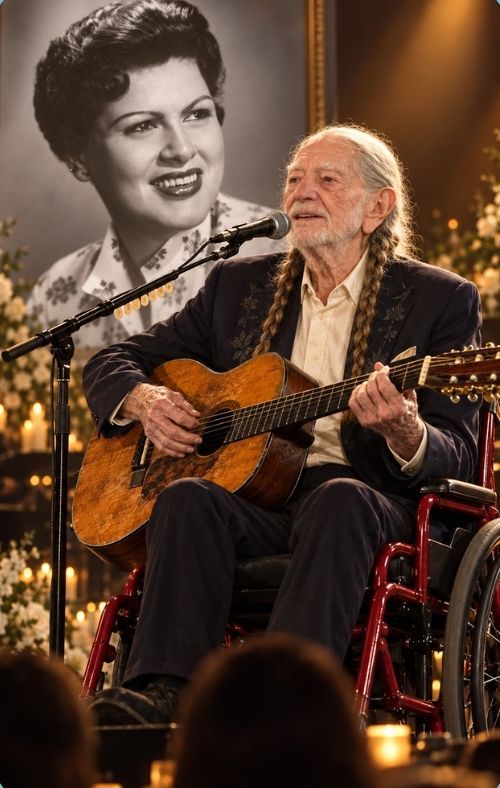
More than six decades after Patsy Cline recorded “Crazy,” the song still feels startlingly intimate. Its melody moves with the elegance of a standard, while its words admit something less orderly: the heart can recognize an impossible hope and hold on to it anyway. Willie Nelson wrote that uneasy truth into the song. Cline gave it a voice listeners could believe.
When “Crazy” became a hit in 1961, Nelson was building his reputation as a songwriter. Cline was already a singer with the rare ability to make a lyric sound both carefully shaped and deeply personal. Their connection through this song was brief in years, yet its effect has lasted a lifetime. Nelson’s writing gave Cline room to express pride, longing, and quiet self-awareness in the same breath. Her performance, in turn, revealed how much feeling lay beneath the song’s graceful surface. The Associated Press identifies “Crazy” as a Nelson composition made famous by Cline.
Listen closely to the way the song unfolds. The melody does not hurry toward a grand declaration. It circles its own thoughts, as though the singer is trying to understand feelings she has already lived with for some time. That movement suits Nelson’s writing: his words are plain enough to remember after one hearing, but they leave space for a performer’s judgment. Cline understood that space. She could let a phrase linger without making it heavy, then bring it gently back to earth.
That balance is one reason “Crazy” has traveled so far beyond its first audience. A younger listener may hear the ache of an uncertain relationship. Someone older may hear memories of the roads a life actually took, along with the roads it might have taken. The song welcomes both readings. It asks for no explanation of the person being missed, and it offers no easy cure for missing them. Its restraint makes the emotion recognizable.
It is tempting to describe Nelson and Cline as partners across the decades, because their names remain so closely joined whenever “Crazy” plays. Their shared work, though, belongs to a particular moment in music history: a songwriter’s composition meeting a singer’s interpretation. Patsy Cline died in 1963, so a claim that the two collaborated for forty years would be misleading. What endured for more than forty years—and continues today—is the recording they brought into the world.
That distinction makes the story more moving. Neither artist could have known how many kitchens, car journeys, radio evenings, and private moments the song would accompany. Nelson went on to build an extraordinary performing career of his own. Cline’s recording remained, preserving the warmth and control of a voice lost far too soon. Every time “Crazy” finds a new listener, their contributions meet again: his understanding of a complicated heart, and her gift for making its confession sound human.
A great recording can keep a moment alive long after the people who made it have left the studio. “Crazy” does exactly that. It lets us hear two remarkable artists doing what each did best—and reminds us why some songs never grow old.