Introduction
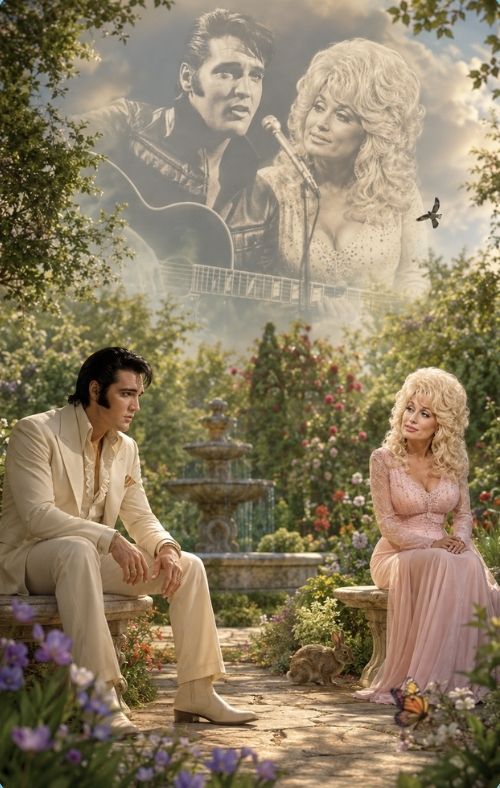
Some musical stories are remembered because of what happened. Others endure because of what almost happened.
Few unfinished chapters in American music carry quite the emotional weight of the story connecting Elvis Presley, Dolly Parton, and “I Will Always Love You.” It is a tale built not around a famous recording, but around the absence of one—a performance listeners can only imagine, a meeting of two unmistakable Southern voices that came remarkably close to becoming part of music history.
They were two of America’s most recognizable voices, yet one extraordinary musical possibility remained forever unfinished. Elvis Presley wanted to record Dolly Parton’s “I Will Always Love You,” but a decision over publishing rights quietly closed the door. Decades later, the story still raises an irresistible question: what might that recording have sounded like?
That question has never entirely disappeared.
When Dolly Parton wrote “I Will Always Love You,” she created something deceptively simple. The song does not depend on grand declarations or complicated storytelling. Its strength lies in restraint. It is about leaving with dignity, holding affection without possession, and recognizing that sometimes the deepest expression of care is knowing when to say goodbye.
That emotional directness made it a natural fit for Elvis Presley.
Elvis possessed the rare ability to make a familiar lyric feel intensely personal. His finest performances often sounded less like demonstrations of vocal power and more like private conversations accidentally overheard by thousands of people. He could bring vulnerability to a ballad without stripping away its strength, and he understood instinctively how to linger over a phrase until it carried more meaning than the words alone seemed capable of holding.
It is not difficult, then, to imagine what Elvis might have discovered inside Dolly’s song.
Perhaps he would have begun quietly, allowing the opening lines to unfold with the tenderness heard in some of his most reflective recordings. Perhaps the arrangement would have grown slowly around him—piano, restrained guitar, soft harmony voices—before his voice rose into one of those sweeping emotional climaxes that made his ballads so memorable.
But the recording never happened.
The familiar account is that Elvis was interested in recording the song, but the business arrangements surrounding publishing rights became an obstacle. Dolly Parton ultimately chose to retain control of the composition rather than surrender a significant share of its publishing. From a songwriter’s point of view, it was an enormously important decision. Publishing ownership can determine not only financial security but also artistic independence, especially across decades.
The choice may have closed one door, but history eventually demonstrated its wisdom.
Still, wisdom does not eliminate curiosity.
Music lovers have continued imagining Elvis singing “I Will Always Love You” because both artists understood something fundamental about emotional storytelling. They came from Southern backgrounds where music was not merely entertainment. Songs could carry faith, family memory, hardship, longing, humor, and hope from one generation to another.
One carried songs into history with his voice; the other wrote them from the heart.
That sentence captures the fascinating contrast between them.
Elvis became one of the most recognizable interpreters of popular music the world had ever known. Dolly became not only a beloved performer but one of American music’s great songwriters, someone capable of taking deeply personal emotions and transforming them into melodies that millions of people could recognize as their own.
An Elvis recording of Dolly’s song might therefore have represented more than a celebrity collaboration. It could have become a meeting between two different forms of musical genius: the interpreter who could inhabit a song completely, and the songwriter who understood how to make complicated feelings sound effortless.
That is why the unfinished recording has taken on an almost mythical quality.
In imagination, the story becomes even more moving.
In this imagined heavenly reunion, the crowds are gone, the contracts are forgotten, and only two Southern storytellers remain. There are no managers discussing percentages, no studios watching the clock, no executives calculating ownership. There is simply a quiet room, perhaps a piano, perhaps a guitar, and two artists who no longer need introductions.
Dolly begins the song exactly as she wrote it—gently, without ornament.
Then Elvis answers.
Not with spectacle. Not with the swagger associated with the most famous years of his career. Instead, imagine the older, reflective Elvis—the singer who understood loneliness, farewell, memory, and the passing of time.
The voices meet on the chorus.
For a moment, the unfinished business of music history disappears.
Of course, such a reunion belongs to imagination. Yet that is precisely why the story continues to fascinate listeners. Music gives us permission to wonder about roads not taken. It allows us to hear, somewhere inside our own minds, performances that never reached a microphone.
And perhaps that is the strange beauty of the Elvis-and-Dolly story.
The missing recording has never grown old because it has never been fixed in time. Every listener can imagine it differently. Some hear a quiet country arrangement. Others hear gospel harmonies. Others imagine Elvis turning the final chorus into a towering farewell while Dolly answers with the gentle clarity that made the original unforgettable.
And somewhere beyond the spotlight, perhaps the duet that never happened finally begins.
History gave us countless recordings from Elvis Presley and Dolly Parton.
But sometimes the song we never heard can be almost as haunting as the ones we did.
Because the greatest “what if” in music history is not always about what was lost.
Sometimes it is about what remains forever possible in the imagination.