Introduction
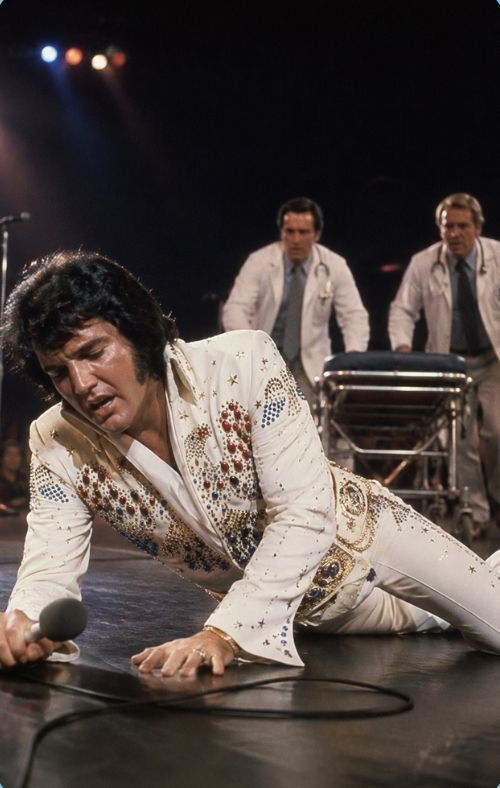
For millions of admirers, Elvis Presley seemed almost indestructible. He had survived changing musical fashions, exhausting tours, Hollywood years, personal disappointments, and the impossible expectations that accompanied being called the King of Rock and Roll. Yet by the summer of 1977, the contrast between the commanding voice audiences heard and the visibly exhausted man carrying that voice had become increasingly difficult to ignore.
It is tempting to describe this period with one dramatic sentence: “THE NIGHT THE KING COLLAPSED: ELVIS FINISHED THE SHOW—THEN HIS BODY GAVE WAY.” The truth, however, is both more complicated and, perhaps, more moving. There is no strong historical evidence that Elvis literally collapsed in front of medical workers immediately after his final Indianapolis concert on June 26, 1977. Contemporary accounts instead describe him completing the performance and leaving the stage after saying goodbye to an enthusiastic audience. Graceland’s official chronology likewise records the Indianapolis appearance as his final concert without describing such a collapse.
But that does not mean the frightening decline behind the legend was imaginary.
Only days earlier, during the final stretch of his touring schedule, Elvis was struggling noticeably. One concert archive reports that during his June 24 performance in Madison, Wisconsin, he complained of stomach pain and was said to have nearly passed out afterward. Other accounts of the 1977 tours describe a performer whose physical stamina had deteriorated dramatically even while flashes of the old musical brilliance remained.
That contradiction is what makes Elvis’s final performances so difficult to watch—and impossible to dismiss.
Onstage, the machinery of the Elvis Presley phenomenon still worked. The orchestra swelled. The scarves appeared. The lights illuminated those famous white jumpsuits. Thousands screamed the moment he entered the room. And when Elvis reached for songs demanding emotional weight rather than youthful athleticism, his voice could still remind listeners why an entire generation had fallen under its spell.
During his final Indianapolis appearance, he performed songs including “Hurt,” “Bridge Over Troubled Water,” “Jailhouse Rock,” and eventually “Can’t Help Falling in Love.” Reports from the evening describe approximately 18,000 people welcoming him with enormous enthusiasm. One contemporary review even noted that he arrived onstage with enough energy to reassure an audience already aware of rumors concerning his health.
Yet photographs and television footage from the same period told another story.
When CBS cameras recorded Elvis in Omaha on June 19 and Rapid City on June 21, viewers could see that the 42-year-old singer was no longer the effortlessly athletic figure remembered from the 1950s and 1960s. The Nebraska State Historical Society describes him as being in poor health during the Omaha performance, even while emphasizing that his voice still produced memorable moments.
That surviving voice is essential to understanding the tragedy.
Elvis did not simply become a man incapable of performing. If anything, the heartbreaking reality was that he could still perform well enough to convince thousands of people, for an hour or so, that everything might somehow be all right.
Then the lights went down.
Behind the applause was a punishing routine involving travel, irregular sleep, chronic illness, prescription medication, enormous professional responsibilities, and a touring organization whose existence depended heavily upon Elvis continuing to appear. Historical examinations of his final years have documented serious health problems and extensive prescription-drug use that contributed to his decline.
There is something almost unbearably human in that image: not Elvis the untouchable icon, but a tired 42-year-old man repeatedly gathering enough strength to walk toward another spotlight.
Less than two months after Indianapolis, Elvis was preparing to return to the road once again. A new tour was scheduled to begin in Portland, Maine, on August 17. He never reached it. On August 16, 1977, he was found unresponsive at Graceland and later pronounced dead.
Seen from that perspective, Elvis Presley’s final concert does not require an invented backstage collapse to become haunting.
The tragedy was already there.
It was present in the exhaustion hidden beneath the rhinestones, in the audience that still demanded one more song, and in the extraordinary voice that continued answering them long after the body carrying it had begun sending unmistakable warnings.
The King finished the performance.
The crowd applauded.
And none of them could have known that they had just watched Elvis Presley walk away from a concert stage for the final time.